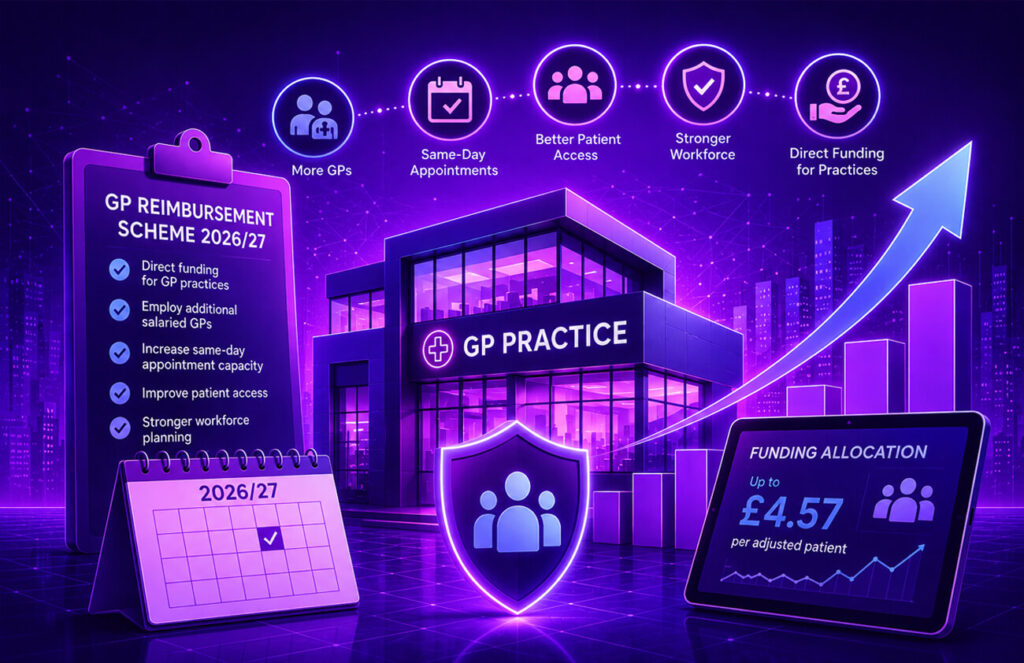
The GP Reimbursement Scheme (GPRS) introduced as part of the 2026/27 GP Contract represents one of the most significant changes to GP practice funding in recent years. It gives eligible GP practices direct access to funding to employ additional salaried GPs and increase same-day appointment capacity, moving away from the previous funding model delivered through Primary Care Networks (PCNs).
For GP partners, understanding how the scheme works is essential. Used correctly, it can help practices improve patient access, strengthen workforce planning and recover a significant proportion of the costs of employing additional salaried GPs.
At forwardlooking Accountants, we advise GP practices on NHS funding, practice finances, partner profit-sharing and strategic workforce planning. This guide explains how the new scheme works and highlights the key financial considerations for GP practices.
What is the GP Reimbursement Scheme?
The GP Reimbursement Scheme was introduced as part of the 2026/27 NHS GP Contract to provide funding directly to GP practices for employing additional salaried GP capacity.
Under previous arrangements, funding for GP capacity was largely delivered through Primary Care Networks (PCNs) using the Capacity and Access Improvement Payment (CAIP). Many practices argued that funding should instead be controlled by individual practices, allowing them greater flexibility to meet local patient demand.
The new scheme responds to those concerns by enabling practices to claim reimbursement for eligible salaried GP employment costs, subject to the scheme rules.
Why was the scheme introduced?
The NHS introduced the scheme to:
- increase access to same-day appointments;
- reduce pressure on GP partners;
- improve patient access to primary care;
- support recruitment and retention of salaried GPs; and
- give practices greater control over workforce planning.
Rather than rewarding practices based on performance measures, the scheme reimburses eligible employment costs for additional salaried GP capacity.
Who can claim?
Eligible GP practices can claim reimbursement for qualifying salaried GP costs through the Calculating Quality Reporting Service (CQRS), subject to the published eligibility criteria.
The scheme is designed to support:
- newly recruited salaried GPs;
- eligible additional sessions worked by existing salaried GPs where these increase clinical capacity; and
- in certain circumstances, locum GPs who are engaged under an appropriate salaried employment arrangement and meet the scheme requirements.
Practices should ensure that any claims fully comply with the published NHS England guidance.
Who cannot benefit?
A common misunderstanding is that GP partners can simply undertake additional clinical sessions and claim reimbursement.
This is not normally the case.
The scheme is intended to reimburse eligible salaried GP employment costs rather than additional sessions undertaken by GP partners in their capacity as partners.
Where partners continue to absorb additional clinical demand themselves, the practice may not be able to access the available funding.
This makes workforce planning particularly important.
Additionality – the key principle
One of the most important concepts within the scheme is additionality.
The funding is intended to create additional GP capacity rather than simply paying for work that would have been carried out anyway.
Practices should therefore ensure they can demonstrate that the reimbursement relates to eligible additional clinical capacity in accordance with the NHS England guidance.
Good record keeping is essential to support any claim.
How is the funding calculated?
Each practice’s annual funding entitlement is based on its adjusted patient list size.
The 2026/27 allocation is calculated using up to £4.57 per adjusted patient, subject to the published scheme rules.
Practices should first calculate their maximum annual entitlement before deciding how many additional salaried GP sessions can be funded.
Reimbursement is generally limited to the lower of:
- the practice’s available funding allocation;
- the actual eligible employment costs incurred; or
- the published annual reimbursement cap (including employer National Insurance and NHS Pension contributions).
Claims are made through CQRS.
Worked example
A GP practice has:
- Adjusted patient list size: 12,500
- Funding rate: £4.57 per adjusted patient
Maximum annual allocation:
12,500 × £4.57 = £57,125
If the practice recruits an additional salaried GP whose eligible employment costs total £52,000, the practice may be able to claim reimbursement of £52,000, provided all eligibility requirements are met.
If eligible costs exceed the practice’s available allocation or the published reimbursement cap, reimbursement will normally be restricted accordingly.
Financial planning opportunities
The introduction of the GP Reimbursement Scheme presents an opportunity for practices to review their workforce strategy.
Questions GP partners should consider include:
- Are partners undertaking clinical sessions that could instead be delivered by a salaried GP?
- Would increasing the sessions of an existing salaried GP be more cost-effective than recruiting?
- Is the practice heavily dependent on locums?
- Can reimbursement reduce overall staffing costs?
- What impact will the changes have on partner drawings and practice cash flow?
These questions require both operational and financial planning.
Common mistakes practices should avoid
Specialist GP accountants frequently identify avoidable errors, including:
- assuming GP partner sessions qualify automatically;
- failing to retain evidence that additional clinical capacity has been created;
- confusing the GP Reimbursement Scheme with ARRS funding;
- failing to understand the reimbursement limits;
- overlooking employer National Insurance and NHS Pension costs when budgeting; and
- missing CQRS claim requirements or deadlines.
Taking professional advice before making staffing decisions can help avoid these issues.
How specialist GP accountants add value
The GP Reimbursement Scheme is not simply about submitting a claim.
Practices should also consider:
- the overall profitability of the practice;
- partner remuneration;
- workforce planning;
- pension implications;
- employer National Insurance costs;
- long-term sustainability; and
- the interaction with other NHS funding streams.
Specialist GP accountants understand how these areas interact and can help practices make informed commercial decisions rather than focusing solely on the reimbursement available.
Frequently Asked Questions
Can GP partners claim under the scheme?
The scheme is intended to reimburse eligible salaried GP employment costs. Additional sessions undertaken by GP partners in their capacity as partners will not normally qualify.
Can existing salaried GPs undertake additional sessions?
Yes, provided the additional sessions satisfy the published eligibility requirements and increase clinical capacity in line with the scheme guidance.
Can locum GPs qualify?
Certain locum arrangements may qualify where the individual is employed under an appropriate salaried arrangement and all scheme conditions are met.
How are claims submitted?
Claims are submitted through the Calculating Quality Reporting Service (CQRS) in accordance with NHS England requirements.
How much funding can a practice receive?
The available funding depends on the practice’s adjusted patient list size, the applicable funding rate and the actual eligible employment costs incurred, subject to the published reimbursement limits.
How Forward looking Accountants can help
As specialist accountants advising GP practices, we provide practical support beyond year-end accounts and tax returns.
We can help you:
- calculate your maximum annual funding entitlement;
- assess whether proposed staffing arrangements meet the scheme requirements;
- prepare financial forecasts before recruiting additional salaried GPs;
- review the impact on partner profits, cash flow and NHS pension costs;
- advise on workforce planning and practice profitability; and
- support your practice in making informed financial decisions.
Our aim is to ensure that GP practices understand not only what funding is available, but also how to use it effectively to strengthen the long-term financial sustainability of the practice.
Final thoughts
The GP Reimbursement Scheme offers a valuable opportunity for GP practices to improve patient access while recovering a significant proportion of eligible salaried GP employment costs.
However, maximising the benefit requires careful workforce planning, an understanding of the eligibility criteria and robust financial forecasting.
Every practice is different. Before making recruitment or staffing decisions, practices should review the detailed NHS England guidance and obtain professional advice tailored to their individual circumstances.
Disclaimer
This article is intended for general information only and does not constitute professional or legal advice. The application of the GP Reimbursement Scheme depends on the individual circumstances of each practice and the detailed requirements of the NHS England GP Contract, CQRS guidance and associated documentation. Professional advice should be obtained before making staffing or financial decisions.